Your heart and kidneys work as a closely linked team, and the health of one shapes the health of the other far more than most people realise.1, 2 Around half of everyone living with heart failure also has chronic kidney disease, a sign of just how tightly these two organs are connected.2 If you have a heart condition, high blood pressure or diabetes, understanding this connection gives you real power to protect both.
Why Your Heart and Kidneys Are More Connected Than You Think
Your heart and kidneys depend on the same continuous flow of blood.3 With every beat, the heart pumps a significant share of blood to the kidneys,3 where it is used to filter waste, balance fluids, and help regulate blood pressure.4 When the heart pumps well, the kidneys receive the steady, pressurised flow they need to function properly.3 When blood flow falls, the kidneys are among the first organs to be affected.5
Think of the heart as the pump and the kidneys as the filter and fluid-control centre.4 The kidneys decide how much salt and water stay in your body, which directly affects how much blood the heart has to move.4 The two organs constantly exchange chemical and pressure signals to keep this balance stable.6 This close partnership is often referred to as the heart and kidney connection.
Because the link works in both directions, a problem in one organ rarely stays contained to that organ.6 Damage to the heart can quickly reduce kidney function, while failing kidneys can place additional strain on the heart.6 Doctors increasingly view heart disease and kidney disease as parts of a single, shared process rather than separate conditions.6 This shared pathway is exactly why looking after one organ helps protect the other. When this close relationship breaks down, it can lead to a condition known as cardiorenal syndrome (CRS).
What Is Cardiorenal Syndrome?
Cardiorenal syndrome refers to the interplay between heart and kidney dysfunction, where impairment in one organ contributes to impairment in the other.6 In simple terms, dysfunction in one organ drives dysfunction in the other, creating a cycle that can worsen over time.6 It is a bidirectional condition, meaning the damage can begin in either the heart or the kidneys.6
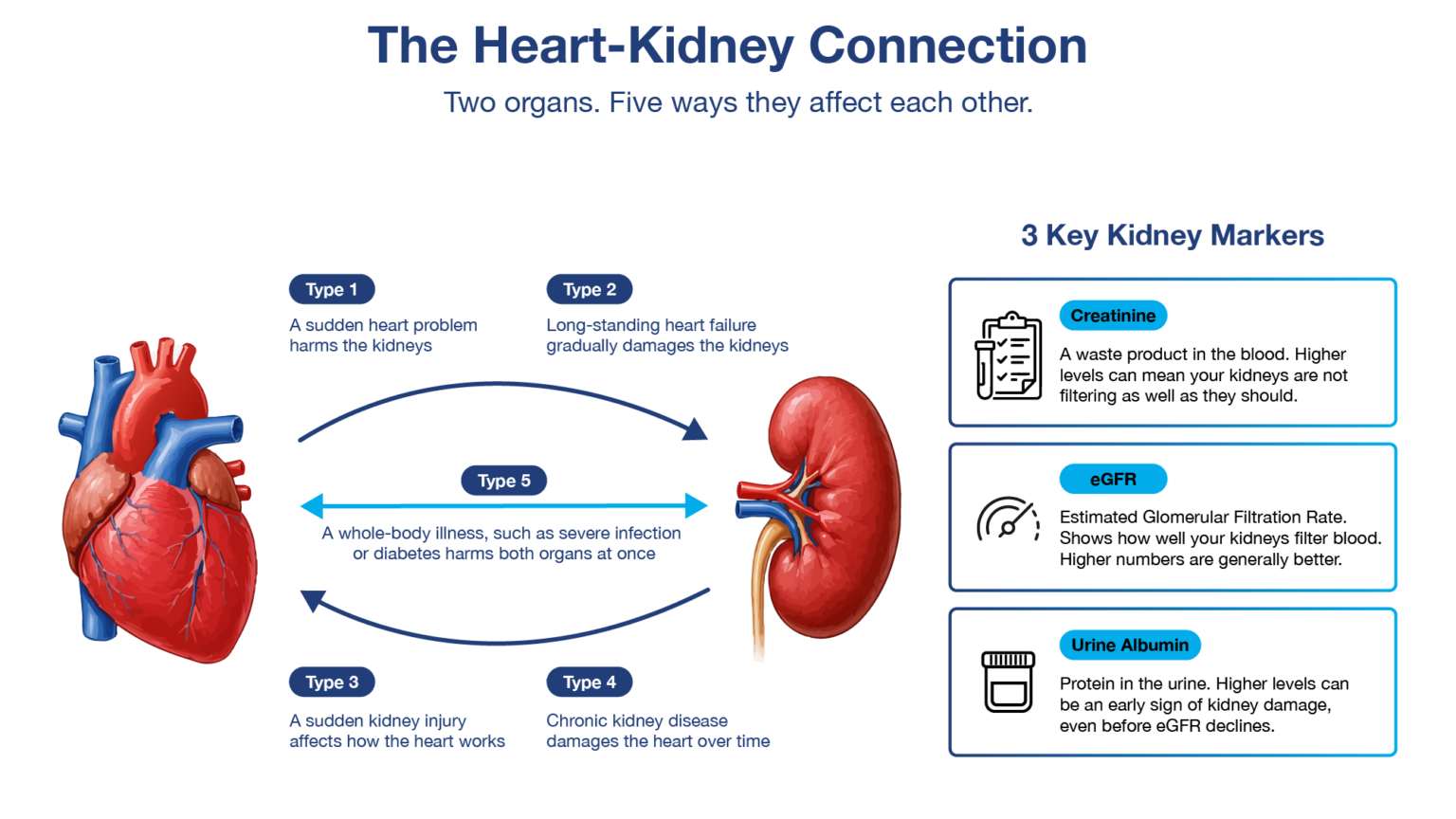
Specialists describe five types of cardiorenal syndrome, grouped by which organ is affected first and whether the condition develops suddenly or over time:6
| Organ affected first | How it affects the other | |
|---|---|---|
| Type 1 | A sudden heart problem | Harms the kidneys |
| Type 2 | Long-standing heart failure | Gradually damages the kidneys |
| Type 3 | A sudden kidney injury | Affects how the heart works |
| Type 4 | Chronic kidney disease | Damages the heart over time |
| Type 5 | A whole-body illness, such as severe infection or diabetes | Harms both organs at once |
This overlap is far from rare. Worsening kidney function occurs in a large share of people admitted to hospital with heart failure, and it signals a tougher recovery and higher risks.5 Recognising cardiorenal syndrome early matters, because the sooner the cycle is identified, the more can be done to slow it.
How Heart Disease Affects Kidney Health
To understand how this cycle develops, it helps to look at how heart problems affect the kidneys.
When the heart cannot pump strongly enough, as happens in heart failure, less blood reaches the kidneys.5 Starved of their normal supply, the kidneys filter less effectively and begin to retain salt and water.5 This helps explain why kidney function often declines during a heart failure flare-up.
Reduced forward flow is only half the story. In heart failure, blood also backs up in the veins and raises the pressure inside them, a process called venous congestion.5 This rising pressure puts strain on the kidneys from the venous side and is now recognised as one of the most important reasons kidney function declines in heart failure.5 Relieving this congestion is a central goal of heart failure treatment.5
When congestive heart failure and kidney disease occur together, the combination becomes especially demanding. People with both conditions face a markedly higher risk of hospital admission and mortality than those with either condition alone.2, 7 Careful, coordinated care of the heart and kidneys offers the best protection in this situation.
Can Kidney Disease Affect Your Heart?
The relationship works in both directions, so it’s only natural to ask: how does kidney disease affect the heart? When the kidneys struggle, they retain extra salt and water and release hormones that push blood pressure up, forcing the heart to work harder against greater resistance.5 Over time this added workload can thicken and stiffen the heart muscle.8
Failing kidneys also disturb the body in ways that extend beyond blood pressure.1 They can trigger anaemia, a shortage of oxygen-carrying red blood cells that leaves the heart pumping faster to compensate.1 Chronic kidney disease (CKD) also fuels low-grade inflammation and upsets the balance of minerals such as potassium, which can interfere with the heart’s rhythm and structure.8
These pressures add up to real danger for the heart. So, can kidney disease cause heart failure, an irregular heartbeat or even a heart attack? Yes, People with CKD carry a higher risk of heart failure, dangerous rhythm disturbances and heart attacks than those with healthy kidneys.8, 9 In fact, cardiovascular disease, not kidney failure itself, is the leading cause of mortality in people with CKD, and 40 to 45% of those with advanced disease lose their lives to heart-related causes.8
Shared Risk Factors: Hypertension, Diabetes and Beyond
Often, the same risk factors damage the heart and kidneys at once. High blood pressure or hypertension, sits at the top of the list.10 It strains the heart while gradually damaging the delicate filtering vessels inside the kidneys, which is why uncontrolled hypertension harms both organs at the same time.8
Doctors even recognise a distinct pattern known as hypertensive heart and chronic kidney disease, in which long-term high blood pressure drives damage to the heart and kidneys side by side.8 Keeping blood pressure within a healthy range therefore ranks among the most powerful things you can do to protect both organs.10
Several other risk factors overlap as well. Diabetes, obesity, and smoking each raise the risk of heart disease and kidney disease, and they often appear together in the same person.2, 8 Because these factors affect both conditions, tackling any one of them brings a double benefit.
Warning Signs Your Heart and Kidneys May Need Attention
These conditions often develop gradually, so recognising the warning signs early is key.
Some symptoms can hint that your heart and kidneys are under pressure together. The signs worth watching for include:
- swelling in the ankles, legs or around the eyes, known medically as oedema, which can indicate fluid the body is struggling to clear1
- breathlessness and unusual tiredness, especially during everyday activity1
- noticeable changes in how often or how much you pass urine1, 10
These warning signs are easy to miss or to attribute to other causes.10 Tiredness is often put down to a busy life, and mild swelling can be dismissed after a long day on your feet. Because heart and kidney problems can build quietly, paying attention to new or worsening symptoms is well worth it.10
Speak to your doctor if swelling, breathlessness or fatigue appears or steadily worsens, especially if you already live with a heart condition, high blood pressure or diabetes.10 Sudden severe breathlessness, chest pain or a marked drop in urine output requires urgent medical attention. Acting early gives your care team the best chance to step in before the cycle gains momentum.
Protecting Your Heart and Kidneys: Steps You Can Take
The encouraging news is that the same habits protect both organs at once. Keeping blood pressure and blood sugar within target ranges eases the strain on your heart and helps protect the kidneys’ fragile filters.8 If you take medicines for these conditions, using them as prescribed is one of the simplest and most effective steps you can take.
What you eat matters too. A balanced diet that is lower in salt helps control blood pressure and reduces the fluid your heart and kidneys must manage.11 A diet rich in vegetables, fruit, whole grains and healthy fats supports both organs, whereas heavily processed foods tend to increase salt and calorie intake.11
Regular physical activity strengthens the heart, helps with weight, and improves blood pressure, so most people benefit from moving more on most days.11 Stopping smoking is just as important, because tobacco damages blood vessels throughout the body and speeds up both heart and kidney disease.11 Your doctor or pharmacist can point you to support that can make a real difference.
Finally, regular monitoring helps keep small problems from becoming large ones. Simple checks can reveal early changes long before you feel unwell: blood pressure, your estimated glomerular filtration rate (eGFR) – a blood test that shows how well your kidneys filter waste from your blood – and urine albumin, which indicates whether the kidneys are leaking protein.4 If you live with a heart or kidney condition, ask how often these should be reviewed.
Small changes can have a powerful impact when it comes to your heart and kidney health. Every step you take to protect one organ also helps protect the other, and you don’t have to navigate this alone. With the right knowledge, regular checks, and a caring team beside you, you can look after both – and make a lasting difference over time.
At Daiichi Sankyo, we are deeply committed to advancing cardiovascular health through research, education, and innovative treatment options. By empowering people to actively manage their health, we aim to help improve patient outcomes. We strive to support clinical communities and healthcare ecosystems to reduce the impact of cardiovascular disease across Europe by raising awareness of holistic health approaches.